

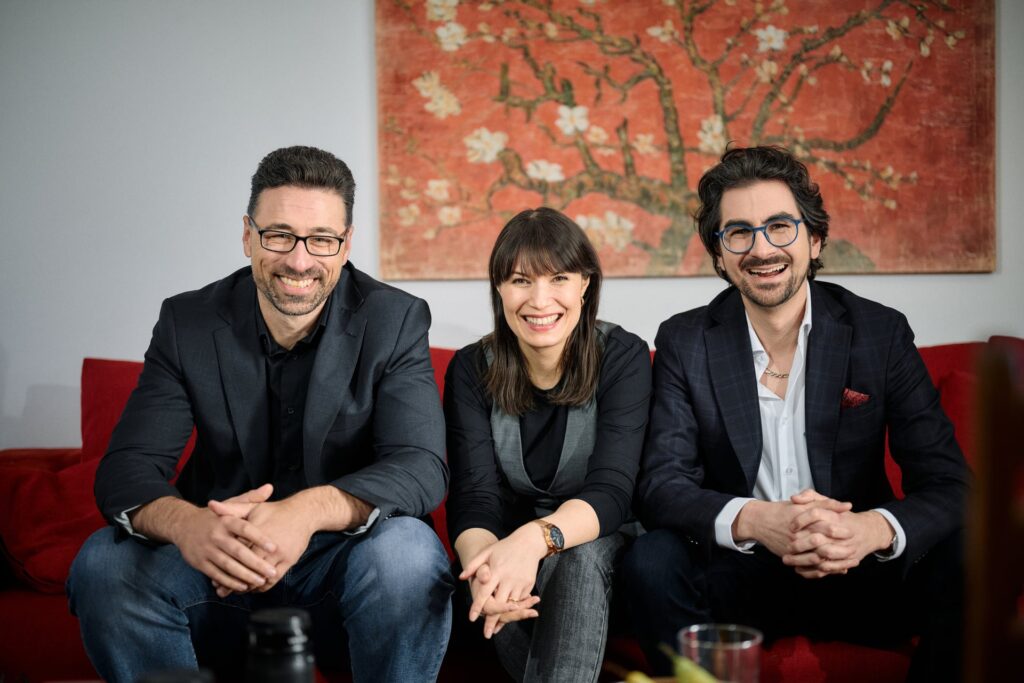
Photo: Ard Jongsma . Left to right: Francisco Mahfuz, Ioana Jongsma, Brian Miller
Three communication experts walk into a bar. Well… an Airbnb!
After years of working together remotely from the US, Spain and Denmark – Brian Miller, Francisco Mahfuz, and I met in person for the very first time last week.
We put ourselves in a bubble to work on new programs for our clients at Clarity Up Consulting.
One of these in particular reminded me how easy it can be to make the wrong decision!
We’re debating which of 3 target groups we should pick first to run a pilot project this fall (stay tuned!!!)
The obvious choice – professional speakers – seems to make total sense: they know us, we know them, we speak the language, we know the pains, easy win on all sides. So we start building the case, mapping out services, we talk through timings, positioning, the whole shebang. We’re pacing, we’re taking notes, we’re moving from the living room to the terrace, from the terrace to the living room. It’s sort of coming together.
Sort of.
I don’t know if it’s the midday Barcelona sun that’s beginning to cook my brain, but it suddenly hits me: I’m working really hard to love this.
Before I know it, I’m saying it out loud.
It’s not that I don’t think professional speakers aren’t perfectly worthy of my service. It’s that the reason for picking them isn’t the right one. I supported the choice not because I felt that’s where I could make the greatest difference, but because it was the path of least resistance. I moved away from effort, not towards impact.
Many times, easy is the absolute smartest way to go.
But for a big commitment like this one, I wanted to make a decision based on what I wanted to gain, not what I wanted to avoid.
Your brain knows the difference
I see this play out in communication decisions all the time.
I see leaders and experts navigating between “this is the right thing / the important thing to say” and “this is the safest thing to say.” I see them choosing the easy talking points. I see them minimising the difficult insight or burying it under disclaimers. I see them hedging.
And I see them spending unnecessary energy trying to feel excited about the words coming out of their mouth.
This isn’t just a mindset problem. It’s neurochemistry.
When we make an avoidance-based decision (choosing what’s safe, minimising friction, reducing energy cost), our brain is running on a specific circuit.
Serotonin helps regulate behavioural inhibition, smoothing the path toward low-risk choices (Boureau & Dayan, 2010, Neuropsychopharmacology). Cortisol compounds the effect: sustained cortisol (often present during high-pressure events) narrows thinking, reduces behavioural flexibility, and shifts decision-making from goal-directed to habitual (Kandasamy et al., 2014, PNAS). It literally makes us more risk-averse, not through careful analysis, but by shrinking the menu of options our brain is willing to consider.
This isn’t a flaw. It’s by design.
These neuromodulators evolved to keep us alive: to minimise risk, avoid threat, and steer us away from danger. For most of human history, that system was essential. But in a modern leadership context, it doesn’t distinguish between a real threat and a challenging communication decision. It just flags both as “hard” and nudges us toward the safer option.
The result: avoidance-based decisions feel productive and rational.
We can build a compelling case to support them. But the energy is that of avoidance, rather than building.
Approach-based decisions run on a different system. Dopamine fuels our willingness to pursue effort-heavy goals when the payoff is meaningful (Salamone & Correa, 2024, Annual Review of Psychology). And norepinephrine mobilises the energy needed to actually face the challenge (Varazzani et al., 2015, Journal of Neuroscience).
This path still costs more energy. It still feels effortful. But dopamine changes our openness to paying that cost. We’re not working hard to love it; we’re working hard because we love it.
That’s exactly what happened in Barcelona.
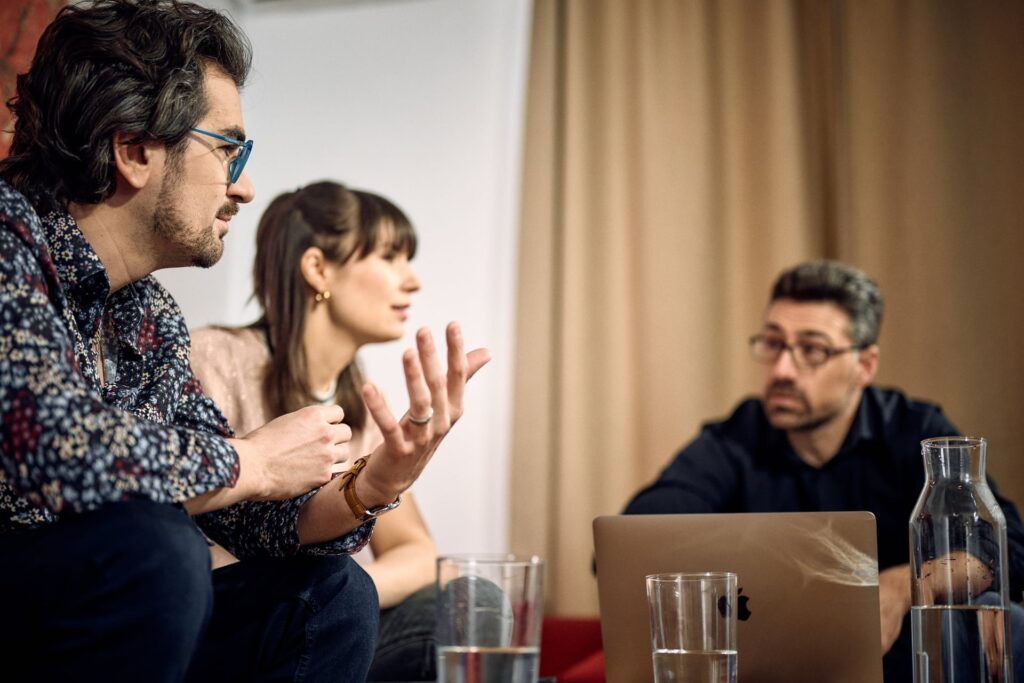
Photo: Ard Jongsma. Left to right: Brian Miller, Ioana Jongsma, Francisco Mahfuz
The obstacle is the way
We shifted from the sensible choice to a higher-effort but more mission-aligned choice: helping experts, engineers, scientists, and researchers communicate their big ideas to the rest of us (again, stay tuned!!!)
By all standards, making technical content clear and attractive to a non-expert audience is one of the toughest communication challenges. But we chose this path because we believe this is where our contribution will be most valuable.
So what does this have to do with you? Ask yourself this: where are you choosing a message not because you love it, or believe in it, but because it saves you some trouble?
Maybe it’s the way you’ve framed a recommendation – burying the real point ten slides deep because leading with it feels too exposed. Maybe it’s the argument you keep rehearsing for the board, adding layers of qualification to something that could be said plainly. Maybe you’re selecting which ideas to share based on what won’t be challenged, rather than what would move the work forward.
The tell is always the same: you’re spending energy on packaging – softening, hedging, over-explaining – instead of just saying the thing (to quote Brian).
These cues are immensely valuable! Notice when you do this, and take a moment. Zoom out. Identify what drives your choices.
Is that word there because it adds meaning? Or because it helps you avoid something? Is that slide there because it serves the audience? Or because it serves a fear of yours? Do you really love your material, or are you working hard to love it?
Away-from-choices and towards-choices can look very similar. Both feel perfectly reasonable.
But one leads to a defensive stance you’ll eventually regret. The other leads to thought leadership.
We chose the latter.
If you’re ready to show up as a Thought Leader…
… let’s connect!
Drop me a line via email, on LinkedIn, or on IG.